The Shift to Agentic Browsing and API Standards
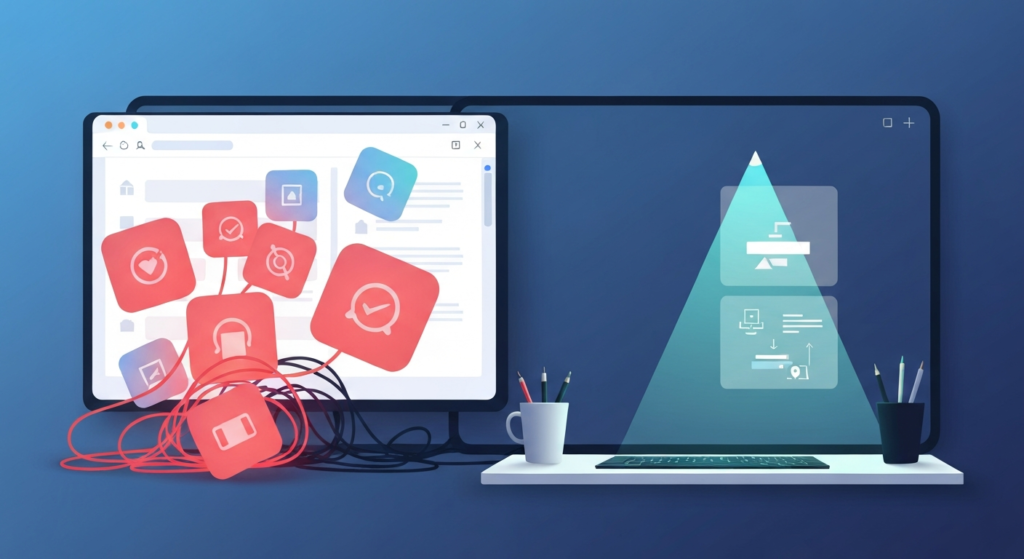
This week’s signal in the Chrome extension ecosystem reveals a clear move toward agentic behavior. Rather than simple assistants, tools are becoming agents capable of executing jobs within authenticated workflows. Chrome is formalizing how these tools interact with AI through WebMCP, while developers gain a more stable, standards-aligned environment via the browser namespace.
Tool of the Week: HoloTab AI Companion
HoloTab, developed by HCompany, is an AI browser companion designed to function as an agent layer. Unlike tools that merely annotate content, HoloTab interacts directly with websites to complete tasks. It targets computer-use behavior—navigating, reading, and acting—making it ideal for teams performing repeatable web-based work like lead research or support triage. It reflects the industry shift from simple utility to goal-oriented agents.
The browser Namespace Lands in Chrome
Starting now, Chrome extension APIs are available under the browser namespace in addition to chrome. This W3C-aligned update simplifies developer workflows significantly. By setting a minimum Chrome version and using browser unconditionally, developers can reduce codebase complexity and future-proof their extensions. For professionals, this means more reliable tools with fewer edge-case failures during daily operations.
| Update/Tool | Key Feature | Workflow Impact |
|---|---|---|
| browser Namespace | Standardized API access | Cleaner, future-proof code |
| WebMCP Trial | Structured AI tools | Deterministic agent actions |
| HoloTab Agent | In-session automation | Reduced manual data loops |
| Chrome 149 | Origin Trial launch | Early access to AI tools |
WebMCP and Structured Tooling Trials
Agentic browsing is becoming more deterministic with the WebMCP origin trial in Chrome 149. This allow websites to declare structured tools that in-browser agents can discover and invoke more transparently. This shift reduces the risk of AI “hallucinations” by establishing a clear contract between the web page and the agent, ensuring that actions like form submissions or searches are handled with higher accuracy.
Trends: From Summaries to Actionable Jobs
The investment landscape is shifting from “AI summaries” to “agentic jobs.” Extensions are no longer just helping you read; they are coordinating multi-step actions across the web. This requires structured contracts, where implicit scraping is replaced by explicit schemas, allowing agents to perform tasks more safely and reliably without brittle heuristics.
Security and Permission Evolution
As agents gain the ability to act inside authenticated sessions, security is becoming a primary differentiator. Professionals should look for tools that offer clear action scopes and permission rationales. Transparent data boundaries will separate high-quality operational tools from “mystery agent” products that pose a security risk in professional environments.
Expert Commentary by Lars Erik Rydberg
The convergence of agentic behavior, formalized tool descriptions, and cleaner API surfaces marks a significant long-term shift. We are moving from assistive browsing to work-executing browsing. For marketers and researchers, the bottleneck is shifting from data retrieval to verification. Developers should focus on reducing integration uncertainty by leveraging these new platform-level capabilities.
My advice is to act selectively. Audit your existing automation extensions and prioritize those that request minimal permissions while explaining their action models clearly. The workflow impact of these changes is here to stay, even as the initial hype cycle for AI assistants settles into practical application.
FAQ: Weekly Browser Tools Digest
What is the benefit of the browser namespace in Chrome?
It aligns Chrome with W3C standards, allowing developers to write cleaner, cross-browser compatible code without relying on complex runtime guards or polyfills.
How does WebMCP improve AI-powered extensions?
WebMCP allows websites to provide structured “tools” directly to AI agents, making browser automation more accurate and less prone to errors compared to traditional screen scraping.
What makes HoloTab different from a standard AI chatbot?
HoloTab is designed for “computer-use,” meaning it can navigate pages and perform actions within a website rather than just generating text based on the visible content.
When will these agentic browsing features be widely available?
The browser namespace is available now, while the WebMCP features are currently entering origin trials starting with Chrome 149 for developer testing.