Home
EpicWebTool Resources
Resources

Resources & Insights

Work faster and smarter. Discover step-by-step guides, expert comparisons, and proven methods to maximize your browser’s efficiency

{
“seo_title”: “The Myth of \”Automation Extensions Always Save Time\””,
“article_text”: “<p>The belief that “automation extensions always save time” is seductive because the browser feels like a workflow factory: click here, fill there, copy somewhere else. If a tool can reduce keystrokes or skip repetitive steps, it sounds like pure efficiency. Many professionals—marketers, developers, founders, and remote teams—adopt extensions to speed up research, reporting, QA, and note-taking. But in practice, time savings can vanish once you account for setup cost, maintenance, failures, and browser performance side effects.</p><h2>The Reality Behind the Automation Myth</h2><p><strong>Myth:</strong> Automation extensions always save time.</p><p><strong>Reality:</strong> Automation extensions can save time—but they often don’t, and sometimes they actively cost time. The “return on automation” is not automatic; it’s conditional on reliability, frictionless setup, minimal interference, and predictable behavior under real browsing conditions.</p><p>In testing across common browser automation patterns (form filling, tab workflows, scraping helpers, email capture, workflow shortcuts), the most frequent outcome is a mismatch between what the extension promises and what the day-to-day workflow actually demands. A brittle automation step that fails once every few sessions can erase minutes of saved effort, because the user still needs to diagnose what happened, fix state, or repeat work manually. Meanwhile, adding more automation features tends to increase the extension’s complexity and runtime footprint, which can slow down page rendering, add delays to DOM updates, or trigger more resource usage—especially when many tabs are open.</p><table><thead><tr><th>Factor</th><th>The Myth</th><th>The Reality</th><th>Practical Impact</th></tr></thead><tbody><tr><td>Reliability</td><td>Guaranteed savings</td><td>Site changes break it</td><td>Manual recovery time</td></tr><tr><td>Performance</td><td>Zero speed impact</td><td>Consumes CPU/RAM</td><td>Slower browser response</td></tr><tr><td>Maintenance</td><td>Set and forget</td><td>Needs regular audits</td><td>Ongoing time tax</td></tr><tr><td>Complexity</td><td>Simple solution</td><td>Adds edge-case bugs</td><td>Workflow interruptions</td></tr></tbody></table><h3>Why Automation Often Fails</h3><p>Most extensions automate actions inside a page by watching the Document Object Model (DOM) or injecting scripts. Since modern websites change frequently due to A/B tests or redesigned components, automation depends on a fragile structure. When the UI changes, the user pays the cost in troubleshooting time, not in the click they originally tried to remove.</p><p>Furthermore, automation isn’t free. Background listeners and frequent DOM polling can increase CPU usage and memory pressure. If an extension adds latency to page load or delays interactions, you lose time repeatedly and silently. It’s also tempting to install “one extension that does everything,” but each additional feature adds settings, permissions, and state handling, leading to permission conflict loops or automation executing in the wrong context.</p><h2>Building a Sustainable Workflow</h2><p>If you want automation to actually save time, treat extensions like production dependencies rather than convenience toys. Use a “time ledger” approach to evaluate a tool: weigh the setup time, run time, failure cost, and maintenance time against the seconds saved per task. A tool that saves 30 seconds but fails unpredictably will lose to consistent manual workflows.</p><p>Design your system for “predictable human override.” Prefer automations that require an explicit trigger, provide visible status (e.g., “applied” or “needs review”), and allow for easy undoing of actions. Avoid silent background actions that modify your work without confirmation. Constrain the scope of your extensions to specific sites to minimize conflicts and security risks.</p><h3>Common Mistakes to Avoid</h3><ul><li><strong>Installing too many extensions:</strong> You cannot measure what is helping, and tools can interfere with each other.</li><li><strong>Trusting popularity:</strong> A widely used extension might not fit your specific data sources or page structures.</li><li><strong>Ignoring privacy:</strong> Automation requires processing page content; ensure you aren’t sending sensitive data to third parties.</li><li><strong>Assuming updates are harmless:</strong> Treat every update as an event that could shift reliability or change behavior unexpectedly.</li><li><strong>Overly complex chaining:</strong> Creating a pipeline of multiple extensions creates a fragile system where one failure stalls the entire process.</li></ul><p>The myth fails because it overlooks the real cost model of browser automation. A better question than “Will this automate?” is: “How much time do I gain after failures, updates, and page variability are included?” That mindset leads to fewer extensions, tighter scope, and cleaner workflows that actually hold up under daily pressure.</p><h3>Frequently Asked Questions</h3><h4>When is a browser extension actually worth the installation?</h4><p>An extension is worth it when the task is high-frequency, the target website is structurally stable, and the tool provides a clear way to manually override or undo automated actions.</p><h4>How can I tell if an extension is slowing down my browser?</h4><p>You can monitor resource usage via the Chrome Task Manager (Shift+Esc). Look for extensions with high CPU usage or those that significantly increase “Scripting” time during page loads.</p><h4>What is the “coordination tax” in web automation?</h4><p>This refers to the time spent fixing, updating, or troubleshooting an automation tool when the underlying website changes its layout or code, often negating the time saved by the tool itself.</p><h4>Should I use “all-in-one” productivity extensions?</h4><p>Generally, no. Specialized, single-purpose extensions are easier to audit for performance and privacy, and they are less likely to cause complex state conflicts compared to “do-everything” tools.</p>“,

“meta_description”: “Is your browser automation actually wasting time? Lars Erik Rydberg debunks the myth that every productivity extension is a net gain for your workflow.”,
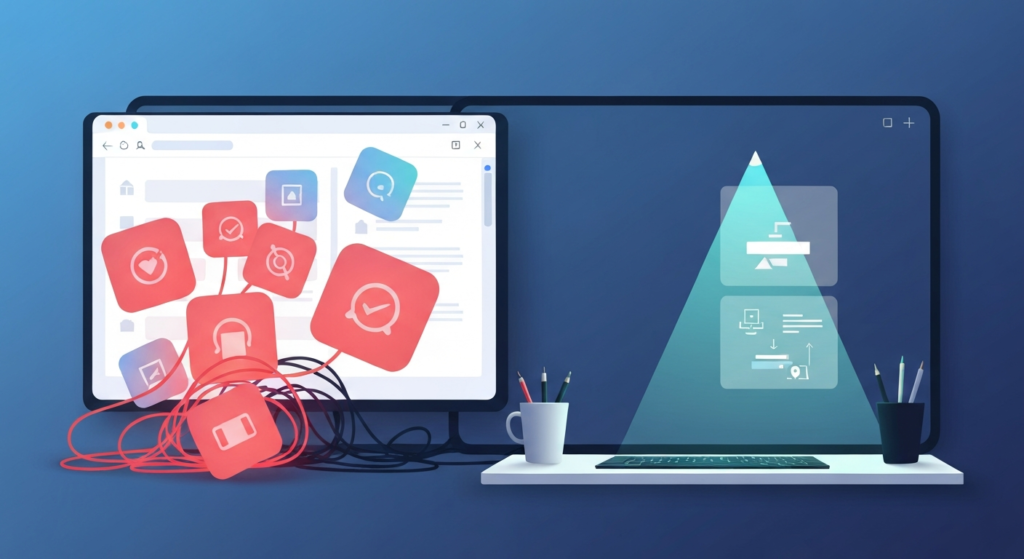
“image_prompt”: “A modern tech editorial illustration showing a split-screen perspective of a professional browser interface. On the left side, a chaotic array of overlapping browser extension icons and broken progress bars representing a clogged, inefficient workflow. On the right side, a clean, minimalist dashboard with one single, glowing, functional automation icon representing effective productivity. Style is clean and professional with a muted, corporate color palette and subtle UI elements.”
}
Tutorial

{ “seo_title”: “The Myth of \”Automation Extensions Always Save Time\””, “article_text”: “<p>The belief that “automation extensions always save time” is seductive because the browser feels like a workflow factory: click here, fill there, copy somewhere else. If a tool can reduce keystrokes or skip repetitive steps, it sounds like pure efficiency. Many professionals—marketers, developers, founders, and remote teams—adopt extensions to speed up research, reporting, QA, and note-taking. But in practice, time savings can vanish once you account for setup cost, maintenance, failures, and browser performance side effects.</p><h2>The Reality Behind the Automation Myth</h2><p><strong>Myth:</strong> Automation extensions always save time.</p><p><strong>Reality:</strong> Automation extensions can save time—but they often don’t, and sometimes they actively cost time. The “return on automation” is not automatic; it’s conditional on reliability, frictionless setup, minimal interference, and predictable behavior under real browsing conditions.</p><p>In testing across common browser automation patterns (form filling, tab workflows, scraping helpers, email capture, workflow shortcuts), the most frequent outcome is a mismatch between what the extension promises and what the day-to-day workflow actually demands. A brittle automation step that fails once every few sessions can erase minutes of saved effort, because the user still needs to diagnose what happened, fix state, or repeat work manually. Meanwhile, adding more automation features tends to increase the extension’s complexity and runtime footprint, which can slow down page rendering, add delays to DOM updates, or trigger more resource usage—especially when many tabs are open.</p><table><thead><tr><th>Factor</th><th>The Myth</th><th>The Reality</th><th>Practical Impact</th></tr></thead><tbody><tr><td>Reliability</td><td>Guaranteed savings</td><td>Site changes break it</td><td>Manual recovery time</td></tr><tr><td>Performance</td><td>Zero speed impact</td><td>Consumes CPU/RAM</td><td>Slower browser response</td></tr><tr><td>Maintenance</td><td>Set and forget</td><td>Needs regular audits</td><td>Ongoing time tax</td></tr><tr><td>Complexity</td><td>Simple solution</td><td>Adds edge-case bugs</td><td>Workflow interruptions</td></tr></tbody></table><h3>Why Automation Often Fails</h3><p>Most extensions automate actions inside a page by watching the Document Object Model (DOM) or injecting scripts. Since modern websites change frequently due to A/B tests or redesigned components, automation depends on a fragile structure. When the UI changes, the user pays the cost in troubleshooting time, not in the click they originally tried to remove.</p><p>Furthermore, automation isn’t free. Background listeners and frequent DOM polling can increase CPU usage and memory pressure. If an extension adds latency to page load or delays interactions, you lose time repeatedly and silently. It’s also tempting to install “one extension that does everything,” but each additional feature adds settings, permissions, and state handling, leading to permission conflict loops or automation executing in the wrong context.</p><h2>Building a Sustainable Workflow</h2><p>If you want automation to actually save time, treat extensions like production dependencies rather than convenience toys. Use a “time ledger” approach to evaluate a tool: weigh the setup time, run time, failure cost, and maintenance time against the seconds saved per task. A tool that saves 30 seconds but fails unpredictably will lose to consistent manual workflows.</p><p>Design your system for “predictable human override.” Prefer automations that require an explicit trigger, provide visible status (e.g., “applied” or “needs review”), and allow for easy undoing of actions. Avoid silent background actions that modify your work without confirmation. Constrain the scope of your extensions to specific sites to minimize conflicts and security risks.</p><h3>Common Mistakes to Avoid</h3><ul><li><strong>Installing too many extensions:</strong> You cannot measure what is helping, and tools can interfere with each other.</li><li><strong>Trusting popularity:</strong> A widely used extension might not fit your specific data sources or page structures.</li><li><strong>Ignoring privacy:</strong> Automation requires processing page content; ensure you aren’t sending sensitive data to third parties.</li><li><strong>Assuming updates are harmless:</strong> Treat every update as an event that could shift reliability or change behavior unexpectedly.</li><li><strong>Overly complex chaining:</strong> Creating a pipeline of multiple extensions creates a fragile system where one failure stalls the entire process.</li></ul><p>The myth fails because it overlooks the real cost model of browser automation. A better question than “Will this automate?” is: “How much time do I gain after failures, updates, and page variability are included?” That mindset leads to fewer extensions, tighter scope, and cleaner workflows that actually hold up under daily pressure.</p><h3>Frequently Asked Questions</h3><h4>When is a browser extension actually worth the installation?</h4><p>An extension is worth it when the task is high-frequency, the target website is structurally stable, and the tool provides a clear way to manually override or undo automated actions.</p><h4>How can I tell if an extension is slowing down my browser?</h4><p>You can monitor resource usage via the Chrome Task Manager (Shift+Esc). Look for extensions with high CPU usage or those that significantly increase “Scripting” time during page loads.</p><h4>What is the “coordination tax” in web automation?</h4><p>This refers to the time spent fixing, updating, or troubleshooting an automation tool when the underlying website changes its layout or code, often negating the time saved by the tool itself.</p><h4>Should I use “all-in-one” productivity extensions?</h4><p>Generally, no. Specialized, single-purpose extensions are easier to audit for performance and privacy, and they are less likely to cause complex state conflicts compared to “do-everything” tools.</p>“, “meta_description”: “Is your browser automation actually wasting time? Lars Erik Rydberg debunks the myth that every productivity extension is a net gain for your workflow.”, “image_prompt”: “A modern tech editorial illustration showing a split-screen perspective of a professional browser interface. On the left side, a chaotic array of overlapping browser extension icons and broken progress bars representing a clogged, inefficient workflow. On the right side, a clean, minimalist dashboard with one single, glowing, functional automation icon representing effective productivity. Style is clean and professional with a muted, corporate color palette and subtle UI elements.” }

{ "seo_title": "The Myth of \"Automation Extensions Always Save Time\"", "article_text": "<p>The belief that “automation extensions always save time” is seductive because the browser feels like a workflow factory: click here, fill there, copy somewhere else. If a tool can reduce keystrokes or skip repetitive steps, it sounds like pure efficiency. Many professionals—marketers, developers, founders, and remote teams—adopt extensions to speed up research, reporting, QA, and note-taking. But in practice, time savings can vanish once you account for setup cost, maintenance, failures, and browser performance side effects.</p><h2>The Reality Behind the Automation Myth</h2><p><strong>Myth:</strong> Automation extensions always save time.</p><p><strong>Reality:</strong> Automation extensions can save time—but they often don’t, and sometimes they actively cost time. The “return on automation” is not automatic; it’s conditional on reliability, frictionless setup, minimal interference, and predictable behavior under real browsing conditions.</p><p>In testing across common browser automation patterns (form filling, tab workflows, scraping helpers, email capture, workflow shortcuts), the most frequent outcome is a mismatch between what the extension promises and what the day-to-day workflow actually demands. A brittle automation step that fails once every few sessions can erase minutes of saved effort, because the user still needs to diagnose what happened, fix state, or repeat work manually. Meanwhile, adding more automation features tends to increase the extension’s complexity and runtime footprint, which can slow down page rendering, add delays to DOM updates, or trigger more resource usage—especially when many tabs are open.</p><table><thead><tr><th>Factor</th><th>The Myth</th><th>The Reality</th><th>Practical Impact</th></tr></thead><tbody><tr><td>Reliability</td><td>Guaranteed savings</td><td>Site changes break it</td><td>Manual recovery time</td></tr><tr><td>Performance</td><td>Zero speed impact</td><td>Consumes CPU/RAM</td><td>Slower browser response</td></tr><tr><td>Maintenance</td><td>Set and forget</td><td>Needs regular audits</td><td>Ongoing time tax</td></tr><tr><td>Complexity</td><td>Simple solution</td><td>Adds edge-case bugs</td><td>Workflow interruptions</td></tr></tbody></table><h3>Why Automation Often Fails</h3><p>Most extensions automate actions inside a page by watching the Document Object Model (DOM) or injecting scripts. Since modern websites change frequently due to A/B tests or redesigned components, automation depends on a fragile structure. When the UI changes, the user pays the cost in troubleshooting time, not in the click they originally tried to remove.</p><p>Furthermore, automation isn’t free. Background listeners and frequent DOM polling can increase CPU usage and memory pressure. If an extension adds latency to page load or delays interactions, you lose time repeatedly and silently. It’s also tempting to install “one extension that does everything,” but each additional feature adds settings, permissions, and state handling, leading to permission conflict loops or automation executing in the wrong context.</p><h2>Building a Sustainable Workflow</h2><p>If you want automation to actually save time, treat extensions like production dependencies rather than convenience toys. Use a “time ledger” approach to evaluate a tool: weigh the setup time, run time, failure cost, and maintenance time against the seconds saved per task. A tool that saves 30 seconds but fails unpredictably will lose to consistent manual workflows.</p><p>Design your system for “predictable human override.” Prefer automations that require an explicit trigger, provide visible status (e.g., “applied” or “needs review”), and allow for easy undoing of actions. Avoid silent background actions that modify your work without confirmation. Constrain the scope of your extensions to specific sites to minimize conflicts and security risks.</p><h3>Common Mistakes to Avoid</h3><ul><li><strong>Installing too many extensions:</strong> You cannot measure what is helping, and tools can interfere with each other.</li><li><strong>Trusting popularity:</strong> A widely used extension might not fit your specific data sources or page structures.</li><li><strong>Ignoring privacy:</strong> Automation requires processing page content; ensure you aren't sending sensitive data to third parties.</li><li><strong>Assuming updates are harmless:</strong> Treat every update as an event that could shift reliability or change behavior unexpectedly.</li><li><strong>Overly complex chaining:</strong> Creating a pipeline of multiple extensions creates a fragile system where one failure stalls the entire process.</li></ul><p>The myth fails because it overlooks the real cost model of browser automation. A better question than “Will this automate?” is: “How much time do I gain after failures, updates, and page variability are included?” That mindset leads to fewer extensions, tighter scope, and cleaner workflows that actually hold up under daily pressure.</p><h3>Frequently Asked Questions</h3><h4>When is a browser extension actually worth the installation?</h4><p>An extension is worth it when the task is high-frequency, the target website is structurally stable, and the tool provides a clear way to manually override or undo automated actions.</p><h4>How can I tell if an extension is slowing down my browser?</h4><p>You can monitor resource usage via the Chrome Task Manager (Shift+Esc). Look for extensions with high CPU usage or those that significantly increase "Scripting" time during page loads.</p><h4>What is the "coordination tax" in web automation?</h4><p>This refers to the time spent fixing, updating, or troubleshooting an automation tool when the underlying website changes its layout or code, often negating the time saved by the tool itself.</p><h4>Should I use "all-in-one" productivity extensions?</h4><p>Generally, no. Specialized, single-purpose extensions are easier to audit for performance and privacy, and they are less likely to cause complex state conflicts compared to "do-everything" tools.</p>", "meta_description": "Is your browser automation actually wasting time? Lars Erik Rydberg debunks the myth that every productivity extension is a net gain for your workflow.", "image_prompt": "A modern tech editorial illustration showing a split-screen perspective of a professional browser interface. On the left side, a chaotic array of overlapping browser extension icons and broken progress bars representing a clogged, inefficient workflow. On the right side, a clean, minimalist dashboard with one single, glowing, functional automation icon representing effective productivity. Style is clean and professional with a muted, corporate color palette and subtle UI elements." }

{
“seo_title”: “The Chrome Store Review Myth: Why Ratings Don’t Equal Safety”,
“article_text”: “<p>Professionals love simple signals. A Chrome Web Store listing with thousands of reviews feels like a “crowd-verified” stamp of safety, especially when you’re under time pressure and need tools that won’t disrupt your day. That’s why the myth persists: star ratings and review comments seem to act like a security audit. But in real browser workflows, reviews often reflect usefulness and annoyance—not safety.</p><h2>Analyzing the Chrome Web Store Review Myth</h2><h3>Myth vs. Reality: The Security Gap</h3><h4>Myth</h4><p><strong>“Chrome Web Store reviews can tell you whether an extension is safe.”</strong></p><h4>Reality</h4><p><strong>Reviews are not a safety mechanism.</strong> They rarely prove an extension’s security posture, privacy behavior, or code integrity. At best, reviews capture user experience after installation—things like performance and utility. They do not reliably indicate if an extension mishandles data or includes risky update patterns. Safety is about what the extension <em>does</em>, not what users <em>feel</em>.</p><table><thead><tr><th>Evaluation Factor</th><th>What Users See</th><th>The Hidden Risk</th></tr></thead><tbody><tr><td>Star Ratings</td><td>Feature utility</td><td>No code audit</td></tr><tr><td>User Reviews</td><td>Speed and UI</td><td>Data leak window</td></tr><tr><td>Popularity</td><td>Mass adoption</td><td>Supply chain risk</td></tr><tr><td>Permissions</td><td>Utility requests</td><td>Over-broad access</td></tr></tbody></table><h2>Proactive Evaluation for Professional Workflows</h2><h5>The Explanation: Why Reviews Fail</h5><p>Reviews can’t guarantee safety because performance is visible while security is opaque. Users notice browser lag or broken layouts, but they cannot see background data transmissions or script injections without inspecting network calls. Furthermore, reviews often lag behind reality; a five-star rating from a previous version does not protect you from malicious behavior introduced in a recent update.</p><h5>Professional Workflow Perspective</h5><ul><li><strong>Scan Permissions First:</strong> Before reading reviews, check the requested host access. If an SEO tool needs to “read and modify data” on all sites, question the necessity.</li><li><strong>Controlled Testing:</strong> Install extensions in a dedicated profile and use browser developer tools to monitor unexpected network requests.</li><li><strong>The Minimalist Stack:</strong> Keep your extension count low. A smaller stack reduces the attack surface and makes it easier to identify performance conflicts.</li></ul><h5>Common Mistakes to Avoid</h5><ul><li><strong>Trusting Popularity:</strong> Assuming that “1 million users” equates to a security certification.</li><li><strong>Ignoring Updates:</strong> Forgetting that an extension’s ownership or code can change overnight, rendering old reviews obsolete.</li><li><strong>Skimming Permissions:</strong> Optimizing for installation speed over data privacy by clicking “Accept” without reading the scope.</li></ul><h5>Conclusion</h5><p>Chrome Web Store reviews help you gauge usefulness, but they are not a substitute for a security audit. To maintain a clean, professional workflow, treat reviews as context, verify permissions manually, and rely on a minimal, well-vetted extension stack. At EpicWebTool, we believe productivity should never come at the cost of unseen security compromises.</p><h3>Frequently Asked Questions</h3><h4>Are “Featured” extensions in the Chrome Web Store safer?</h4><p>While “Featured” extensions follow Google’s best practices for UX and performance, they are still subject to updates and third-party dependencies. They are generally more reputable, but you should still verify their permission scope manually.</p><h4>What is the most dangerous permission an extension can ask for?</h4><p>The permission to “Read and change all your data on the websites you visit” is the most significant. It allows the extension to interact with almost anything in your browser, including passwords and financial information entered into forms.</p><h4>How can I check an extension’s safety without reading reviews?</h4><p>Check the “Privacy practices” tab on the store listing, audit the requested permissions, and look for a link to a public source code repository or a detailed privacy policy that explains data handling.</p>“,
“meta_description”: “Think a 5-star rating means a Chrome extension is safe? Learn why Web Store reviews are misleading and how to verify security before you install your next tool.”,
“image_prompt”: “A modern editorial tech illustration featuring a gold five-star rating badge that is partially translucent. Behind the stars, complex digital circuitry and lines of code are visible, with a small warning icon glowing in red. The background is a clean, professional minimalist software dashboard in muted blues and greys. No text.”
}
Tutorial

{ “seo_title”: “The Chrome Store Review Myth: Why Ratings Don’t Equal Safety”, “article_text”: “<p>Professionals love simple signals. A Chrome Web Store listing with thousands of reviews feels like a “crowd-verified” stamp of safety, especially when you’re under time pressure and need tools that won’t disrupt your day. That’s why the myth persists: star ratings and review comments seem to act like a security audit. But in real browser workflows, reviews often reflect usefulness and annoyance—not safety.</p><h2>Analyzing the Chrome Web Store Review Myth</h2><h3>Myth vs. Reality: The Security Gap</h3><h4>Myth</h4><p><strong>“Chrome Web Store reviews can tell you whether an extension is safe.”</strong></p><h4>Reality</h4><p><strong>Reviews are not a safety mechanism.</strong> They rarely prove an extension’s security posture, privacy behavior, or code integrity. At best, reviews capture user experience after installation—things like performance and utility. They do not reliably indicate if an extension mishandles data or includes risky update patterns. Safety is about what the extension <em>does</em>, not what users <em>feel</em>.</p><table><thead><tr><th>Evaluation Factor</th><th>What Users See</th><th>The Hidden Risk</th></tr></thead><tbody><tr><td>Star Ratings</td><td>Feature utility</td><td>No code audit</td></tr><tr><td>User Reviews</td><td>Speed and UI</td><td>Data leak window</td></tr><tr><td>Popularity</td><td>Mass adoption</td><td>Supply chain risk</td></tr><tr><td>Permissions</td><td>Utility requests</td><td>Over-broad access</td></tr></tbody></table><h2>Proactive Evaluation for Professional Workflows</h2><h5>The Explanation: Why Reviews Fail</h5><p>Reviews can’t guarantee safety because performance is visible while security is opaque. Users notice browser lag or broken layouts, but they cannot see background data transmissions or script injections without inspecting network calls. Furthermore, reviews often lag behind reality; a five-star rating from a previous version does not protect you from malicious behavior introduced in a recent update.</p><h5>Professional Workflow Perspective</h5><ul><li><strong>Scan Permissions First:</strong> Before reading reviews, check the requested host access. If an SEO tool needs to “read and modify data” on all sites, question the necessity.</li><li><strong>Controlled Testing:</strong> Install extensions in a dedicated profile and use browser developer tools to monitor unexpected network requests.</li><li><strong>The Minimalist Stack:</strong> Keep your extension count low. A smaller stack reduces the attack surface and makes it easier to identify performance conflicts.</li></ul><h5>Common Mistakes to Avoid</h5><ul><li><strong>Trusting Popularity:</strong> Assuming that “1 million users” equates to a security certification.</li><li><strong>Ignoring Updates:</strong> Forgetting that an extension’s ownership or code can change overnight, rendering old reviews obsolete.</li><li><strong>Skimming Permissions:</strong> Optimizing for installation speed over data privacy by clicking “Accept” without reading the scope.</li></ul><h5>Conclusion</h5><p>Chrome Web Store reviews help you gauge usefulness, but they are not a substitute for a security audit. To maintain a clean, professional workflow, treat reviews as context, verify permissions manually, and rely on a minimal, well-vetted extension stack. At EpicWebTool, we believe productivity should never come at the cost of unseen security compromises.</p><h3>Frequently Asked Questions</h3><h4>Are “Featured” extensions in the Chrome Web Store safer?</h4><p>While “Featured” extensions follow Google’s best practices for UX and performance, they are still subject to updates and third-party dependencies. They are generally more reputable, but you should still verify their permission scope manually.</p><h4>What is the most dangerous permission an extension can ask for?</h4><p>The permission to “Read and change all your data on the websites you visit” is the most significant. It allows the extension to interact with almost anything in your browser, including passwords and financial information entered into forms.</p><h4>How can I check an extension’s safety without reading reviews?</h4><p>Check the “Privacy practices” tab on the store listing, audit the requested permissions, and look for a link to a public source code repository or a detailed privacy policy that explains data handling.</p>“, “meta_description”: “Think a 5-star rating means a Chrome extension is safe? Learn why Web Store reviews are misleading and how to verify security before you install your next tool.”, “image_prompt”: “A modern editorial tech illustration featuring a gold five-star rating badge that is partially translucent. Behind the stars, complex digital circuitry and lines of code are visible, with a small warning icon glowing in red. The background is a clean, professional minimalist software dashboard in muted blues and greys. No text.” }

{ "seo_title": "The Chrome Store Review Myth: Why Ratings Don't Equal Safety", "article_text": "<p>Professionals love simple signals. A Chrome Web Store listing with thousands of reviews feels like a “crowd-verified” stamp of safety, especially when you’re under time pressure and need tools that won’t disrupt your day. That’s why the myth persists: star ratings and review comments seem to act like a security audit. But in real browser workflows, reviews often reflect usefulness and annoyance—not safety.</p><h2>Analyzing the Chrome Web Store Review Myth</h2><h3>Myth vs. Reality: The Security Gap</h3><h4>Myth</h4><p><strong>“Chrome Web Store reviews can tell you whether an extension is safe.”</strong></p><h4>Reality</h4><p><strong>Reviews are not a safety mechanism.</strong> They rarely prove an extension’s security posture, privacy behavior, or code integrity. At best, reviews capture user experience after installation—things like performance and utility. They do not reliably indicate if an extension mishandles data or includes risky update patterns. Safety is about what the extension <em>does</em>, not what users <em>feel</em>.</p><table><thead><tr><th>Evaluation Factor</th><th>What Users See</th><th>The Hidden Risk</th></tr></thead><tbody><tr><td>Star Ratings</td><td>Feature utility</td><td>No code audit</td></tr><tr><td>User Reviews</td><td>Speed and UI</td><td>Data leak window</td></tr><tr><td>Popularity</td><td>Mass adoption</td><td>Supply chain risk</td></tr><tr><td>Permissions</td><td>Utility requests</td><td>Over-broad access</td></tr></tbody></table><h2>Proactive Evaluation for Professional Workflows</h2><h5>The Explanation: Why Reviews Fail</h5><p>Reviews can't guarantee safety because performance is visible while security is opaque. Users notice browser lag or broken layouts, but they cannot see background data transmissions or script injections without inspecting network calls. Furthermore, reviews often lag behind reality; a five-star rating from a previous version does not protect you from malicious behavior introduced in a recent update.</p><h5>Professional Workflow Perspective</h5><ul><li><strong>Scan Permissions First:</strong> Before reading reviews, check the requested host access. If an SEO tool needs to “read and modify data” on all sites, question the necessity.</li><li><strong>Controlled Testing:</strong> Install extensions in a dedicated profile and use browser developer tools to monitor unexpected network requests.</li><li><strong>The Minimalist Stack:</strong> Keep your extension count low. A smaller stack reduces the attack surface and makes it easier to identify performance conflicts.</li></ul><h5>Common Mistakes to Avoid</h5><ul><li><strong>Trusting Popularity:</strong> Assuming that “1 million users” equates to a security certification.</li><li><strong>Ignoring Updates:</strong> Forgetting that an extension's ownership or code can change overnight, rendering old reviews obsolete.</li><li><strong>Skimming Permissions:</strong> Optimizing for installation speed over data privacy by clicking “Accept” without reading the scope.</li></ul><h5>Conclusion</h5><p>Chrome Web Store reviews help you gauge usefulness, but they are not a substitute for a security audit. To maintain a clean, professional workflow, treat reviews as context, verify permissions manually, and rely on a minimal, well-vetted extension stack. At EpicWebTool, we believe productivity should never come at the cost of unseen security compromises.</p><h3>Frequently Asked Questions</h3><h4>Are "Featured" extensions in the Chrome Web Store safer?</h4><p>While "Featured" extensions follow Google’s best practices for UX and performance, they are still subject to updates and third-party dependencies. They are generally more reputable, but you should still verify their permission scope manually.</p><h4>What is the most dangerous permission an extension can ask for?</h4><p>The permission to “Read and change all your data on the websites you visit” is the most significant. It allows the extension to interact with almost anything in your browser, including passwords and financial information entered into forms.</p><h4>How can I check an extension's safety without reading reviews?</h4><p>Check the "Privacy practices" tab on the store listing, audit the requested permissions, and look for a link to a public source code repository or a detailed privacy policy that explains data handling.</p>", "meta_description": "Think a 5-star rating means a Chrome extension is safe? Learn why Web Store reviews are misleading and how to verify security before you install your next tool.", "image_prompt": "A modern editorial tech illustration featuring a gold five-star rating badge that is partially translucent. Behind the stars, complex digital circuitry and lines of code are visible, with a small warning icon glowing in red. The background is a clean, professional minimalist software dashboard in muted blues and greys. No text." }

Beyond the Shortcut – Elevating Your Chrome Screen Capture Game on macOS
Blog

Beyond the Shortcut – Elevating Your Chrome Screen Capture Game on macOS

Screen Grabbing Tool for Chrome Screen grab tools are extremely useful for QA testers, developers, online learning, and communication with support teams. Screenshot – a convenient way to save important information Screen grab tools allow you to capture screenshots or record on-screen activity. They are used to save full or partial screen images, record video, […]

The Big Picture – Capturing Every Pixel with Seamless Full-Page Technology
Blog

The Big Picture – Capturing Every Pixel with Seamless Full-Page Technology

Full-page Screenshot Capture Extension The EpicWebTool platform helps users consciously choose only reliable, high-quality screenshot apps. We offer expert-validated Chrome extensions A full page screenshot extension is a browser tool that allows you to capture an entire web page – not just the visible screen area. These extensions are available for multiple browsers, including Google […]

Beyond the Snapshot – Mastering High-Speed Screen Captures in One Click
Blog

Beyond the Snapshot – Mastering High-Speed Screen Captures in One Click

Screenshot Capture Extension for Chrome Google Chrome extensions are small programs that add new functionality to the browser or simplify everyday web usage. They improve workflows, increase productivity, and enhance security and privacy. We offer the best expert-approved extensions A screen capture extension is a lightweight tool installed in Google Chrome that allows you to: […]

The Chrome Evolution – Why Your Browser Needs This Professional Visual Edge
Blog

The Chrome Evolution – Why Your Browser Needs This Professional Visual Edge

Screenshot Extension for Google Chrome Google Chrome is the most popular web browser in the world, known for its speed, intuitive navigation, security (including built-in protection against malicious sites), and seamless data synchronization across devices. Most extensions are available for free Why do you need extensions? Well, a browser handles basic tasks, such as opening […]

Precision on macOS – Redefining the Screenshot Experience for the Modern MacBook User
Blog

Precision on macOS – Redefining the Screenshot Experience for the Modern MacBook User

Screen Capture App for Mac A screen grab application is software used to capture screenshots or record on-screen activity (video capture). Key benefits include: fast capture of important information; convenience for work and learning – ideal for creating tutorials, explaining tasks, and demonstrating issues; time savings and improved communication – screenshots and videos help convey […]

Record Your Screen in Chrome: Free Plugins That Work
Blog

Record Your Screen in Chrome: Free Plugins That Work

FREE Screen Recorder Plugin EpicWebTool is an independent expert platform that sets the quality standard in the world of web apps and browser tools. We help users make informed decisions when choosing the best browser extensions. Reach out anytime to download the extension you need. Want to use free extensions? Popular free screen recording extensions […]

Full-Page Capture Plugins Every Chrome User Needs
Blog

Full-Page Capture Plugins Every Chrome User Needs

Screenshot Plugin for Google Chrome Want to create fast and high-quality screenshot capture files? Choose reliable tools on our platform. Extensions for creating screenshots in Google Chrome EpicWebTool exists to help users separate high-quality products from marketing noise. We bring together expert comparisons, in-depth quality validation, a curated catalog of trusted tools, and proprietary products […]

Chrome Extensions That Turn Screenshots Into Art
Blog

Chrome Extensions That Turn Screenshots Into Art

Screen Grab Extension for Chrome Choose guaranteed high-quality screenshot applications approved by experts. On EpicWebTool, you’ll only find reliable and thoroughly validated tools – all decisions are based on experience, not trends. The browser tools we recommend are dependable productivity assistants trusted by our users. Working with us is simple and transparent – reach out […]

Windows & Mac Screen Grab Apps That Deliver Results
Blog

Windows & Mac Screen Grab Apps That Deliver Results

Screen Grabber App for Windows & Mac The educational platform EpicWebTool brings together expert comparisons, in-depth quality validation, and a curated catalog of trusted tools. We also offer proprietary products created under the guidance of founder Lars Erik Rydberg, who has over 15 years of experience in web applications, browser tools, and Chrome extensions. Best […]

PC Screen Grabbers Worth Downloading Today
Blog

PC Screen Grabbers Worth Downloading Today

Screen Grabber for PC EpicWebTool is an expert benchmark for conscious selection of web apps and browser tools. We provide high-quality screenshot software for PC that you can download today. The EpicWebTool platform brings together: expert comparisons; in-depth quality validation based on technical and product criteria; a curated catalog of vetted tools; proprietary products created […]

Screen Capture Software for Mac: Free, Fast, and Reliable
Blog

Screen Capture Software for Mac: Free, Fast, and Reliable

Screen Capture App for Mac We offer high-quality screenshot applications that have been tested and approved by experts. The independent platform EpicWebTool was created to help users, teams, and businesses choose the best truly effective and user-friendly web tools – not random products driven by marketing promises. We are not a marketplace. We are an […]

Mac Screenshot Tools That Make Capturing Effortless
Blog

Mac Screenshot Tools That Make Capturing Effortless

Screenshot App for Mac OS On the educational and independent platform EpicWebTool, you can download high-quality applications approved by experts. We offer reliable and efficient software Key advantages of using a Mac OS screenshot app include: advanced capture options – selected window or specific screen area; built-in editor – instantly add comments, arrows, text, geometric […]

The Best Print Screen Apps for Windows & Mac You’ll Actually Use
Blog

The Best Print Screen Apps for Windows & Mac You’ll Actually Use

Print Screen App for Windows 10 & Mac EpicWebTool is an educational and independent expert platform in the web applications and browser tools space. It was created to reduce chaos in tool selection, increase trust across the industry, and separate high-quality products from marketing noise. We offer the best applications that expand browser functionality, enhance […]

Turn Up the Volume – Chrome’s Top Speaker Booster Extensions
Blog

Turn Up the Volume – Chrome’s Top Speaker Booster Extensions

BEST Speaker Volume Booster for PC The Sound Booster extension for Google Chrome is an ideal solution for making videos and streams louder. This browser add-on compensates for low audio levels in videos, music, or other media files. Extensions that boost sound beyond standard device limits On EpicWebTool, you can download a reliable volume booster. […]

Click, Snap, Share – The Best Free Screenshot Extension for PC
Blog

Click, Snap, Share – The Best Free Screenshot Extension for PC

BEST Screenshot Taker for PC The screenshot extensions featured on EpicWebTool add essential functionality to your browser. They allow you to capture images from web pages or your screen, add annotations, blur sensitive elements, and instantly share screenshots. Our independent expert platform was created to help users, teams, and businesses choose truly high-quality web tools […]

Snip Smarter – The Best Chromebook Screenshot Tools You Need
Blog

Snip Smarter – The Best Chromebook Screenshot Tools You Need

BEST Snipping Tool for Chromebook Browser extensions provide real value by automating routine tasks, saving time, increasing productivity, and improving both comfort and security while browsing the web. However, it’s important to remember that some extensions may collect personal data. That’s why we recommend installing only verified add-ons. EpicWebTool is an educational and independent expert […]